Nobody ever got fired for buying IBM
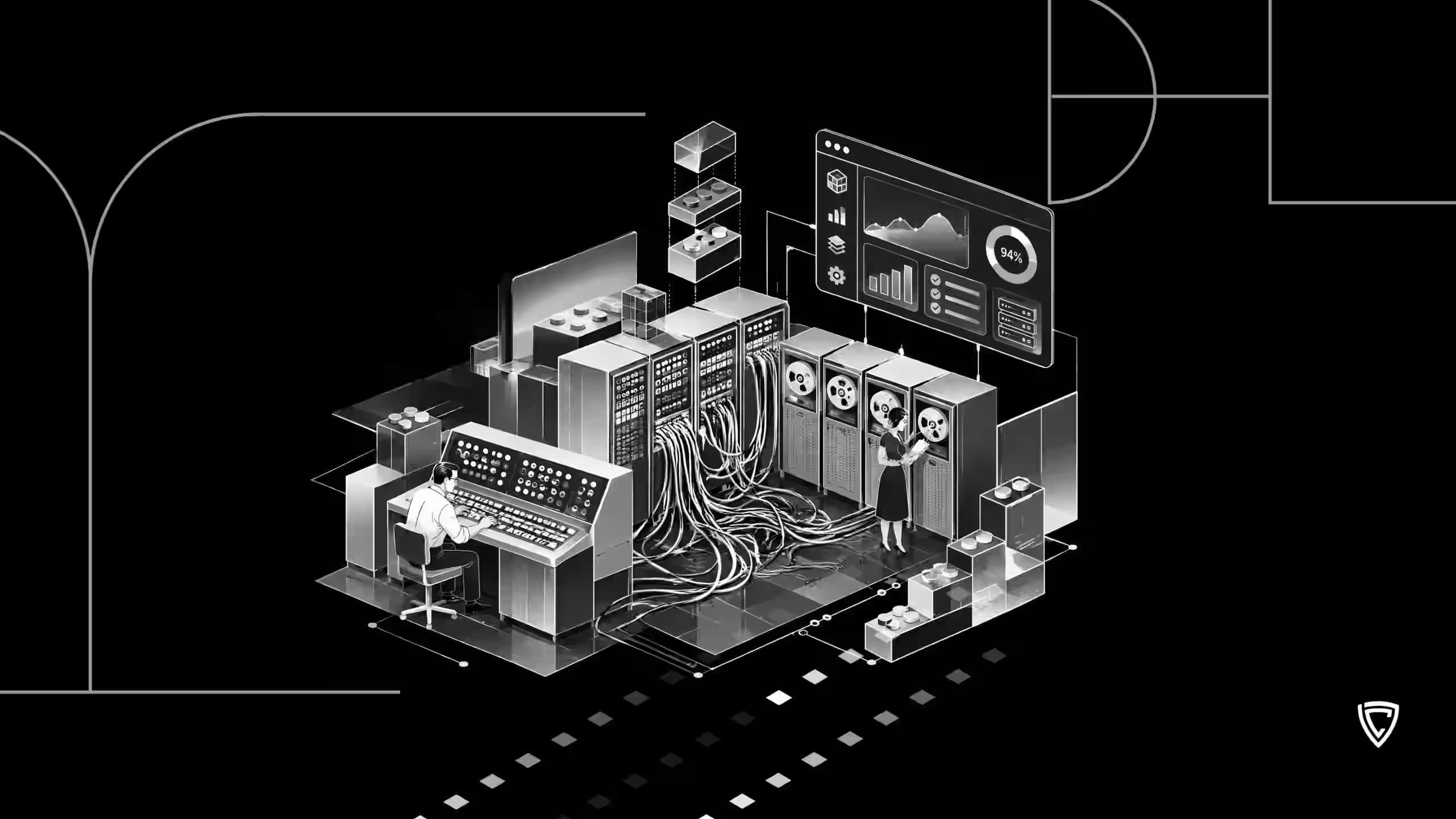
To many people reading this, IBM might barely ring a bell: a company that built computers sometime before the internet arrived. Anyone with an interest in the history of the tech industry will know how far short of it that falls. IBM sits in the direct line that runs from the punch card right through to the machines now writing our software for us.
From the early 1960s to the late 1980s it held somewhere between 70 and 80 per cent of the global computer market, and owned the infrastructure of business, banking and government. Its dominance was so complete that, for an IT or purchase manager in a bank, a government department or any large business, choosing IBM was not really a technology decision. It was a protective shield. Hence the phrase that outlived the era: nobody ever got fired for buying IBM.
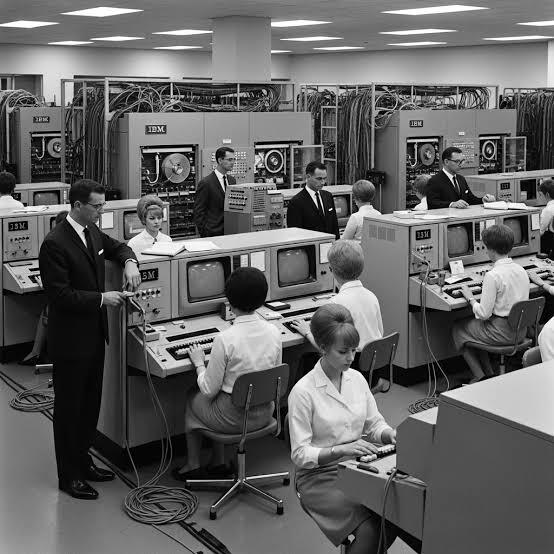
The logic was sound. Large technology projects failed often, and when the IBM project failed, the failure was structural. Choose a smaller supplier, have exactly the same thing happen, and the failure had your name on it. So the phrase was never really a claim about product quality. It was a claim about where the blame would land, and for a long stretch of corporate history it was simply correct.
What has changed since the heyday of IBM
In IBM's era, building business technology was a heroic undertaking. There was no cloud to rent, no open-source library to start from, no API to call. An enterprise-grade system meant years of development, millions in capital expenditure, scarce engineers and a multi-year implementation, after which nobody wanted to go through the process again. Conditions like that did not just favour the incumbent. They practically guaranteed one.
Almost none of that is true now. Infrastructure is rented by the hour, mature components cover much of what used to be built from scratch, and a well-funded, well-led company can reach enterprise grade in a few years rather than a few decades, on the most modern foundations available. The other side of that coin is that technology ages quickly. What looked cutting edge five years ago may look dated today, and what was designed twenty years ago was designed for a world that no longer exists.

Expectations have moved just as fast. In the 1960s a decade could pass without a client expecting anything materially better. Today the people using your systems at work spend the rest of their day in some of the best-engineered applications in the world, and they do not lower their expectations because the software in front of them happens to be enterprise software.
So buyers now have far more credible choices, and far more pressure to choose well. The protective shield has turned around completely. Today the decision most likely to come back on you is the one that would have felt safest in IBM's heyday: the familiar brand, chosen when better options were plainly available.
How technology platforms should be chosen in 2026
If brand and heritage are no longer a reliable guide, something has to replace them. In my experience, four things tell you most of what you need to know.
1. Modern foundations
A platform can only ever be as modern as the infrastructure it is built on. Systems that are cloud native and API first were designed from the outset to scale, to be secure by default and to talk to other systems. Systems that were not were designed for a world of on-premise servers and closed boundaries, and however much is layered over the top, the foundations still show.
This matters for four reasons. It determines whether the platform can deliver the kind of digital experience your users now take for granted. It determines how easily it connects with the rest of your own systems. It determines whether it can exchange data with the partners and counterparties in your wider ecosystem, which is increasingly where the value lies. And it determines whether it can be extended in the future. Modern platforms are built from components that can be added to, replaced and recombined. Older ones were built as a single block, and every change is harder than the last. The result is that they do not simply stand still. They fall further behind every year and become more and more expensive to maintain and secure. If you are considering a platform that was built pre-cloud, I would strongly advise bringing in technical expertise to ask the hard questions.
2. Configurable, not customised
Every organisation is different, and every organisation is changing. Suppliers often use configurable and customisable interchangeably, but they mean almost opposite things. Customisation is hard-coded to fit you on day one, and when your business or strategy moves, it cannot move with you without significant cost. Configuration can be reshaped again and again without new code, from the data model to the interface, and it is only possible on a componentised platform built around a clear, adaptable data model. Ask which of the two you are being offered, and then ask to see it. I would be highly suspicious of configuration that can only be done behind the scenes by tech people, as that would sound very much like customisation to me. If it's truly configurable, there should be administrative screens where you can see how it happens yourself.
Customisation fits you on day one. Configuration fits you on day one thousand.
3. User experience, and what it tells you
The interface matters first for the obvious reason. Your people, and the people at every partner who interacts with the platform, will not be efficient on clumsy screens, and they will not be happy on them either. They expect clean, intuitive software of the kind they use everywhere else in their lives, and they are right to.
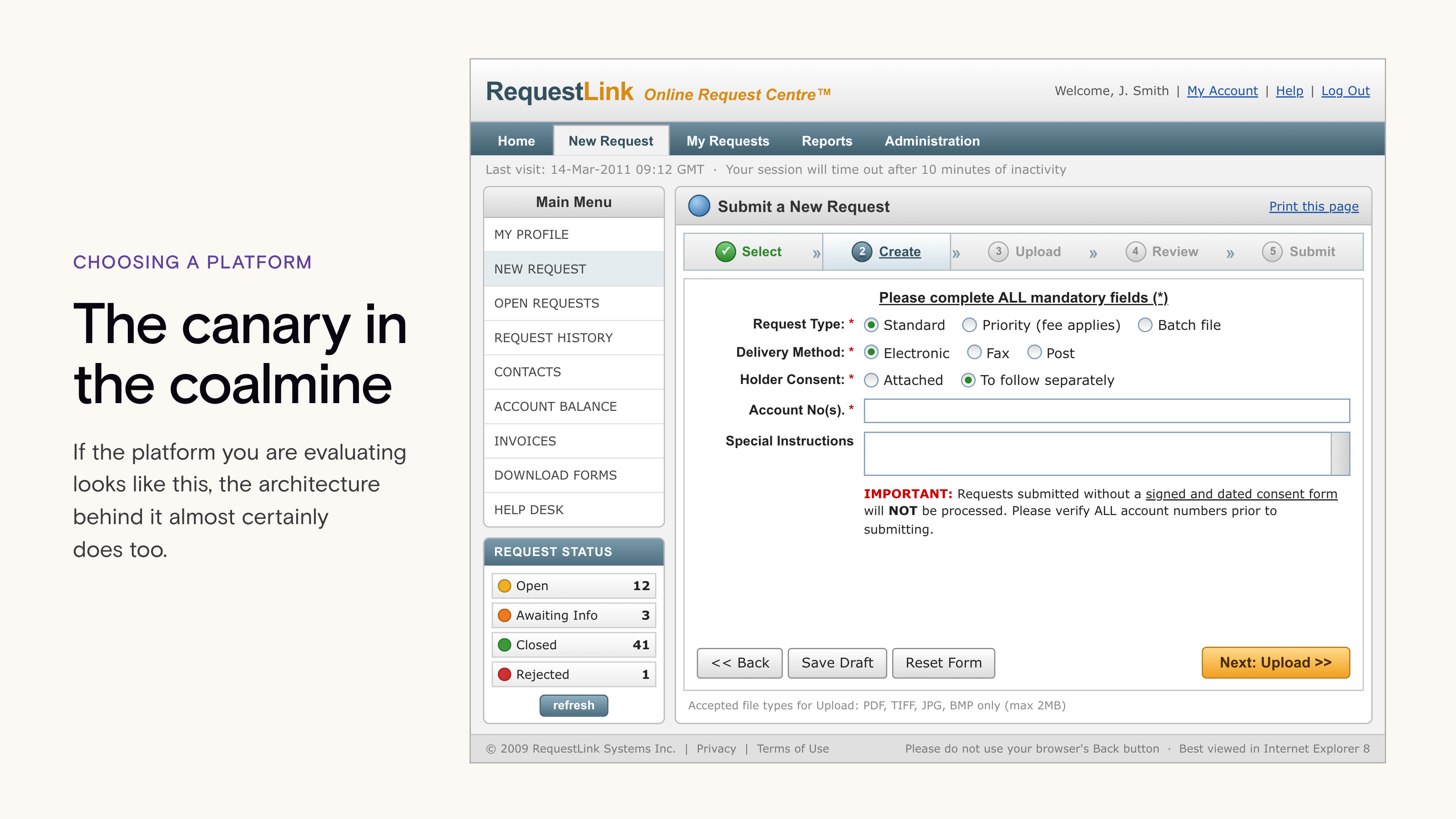
But the interface also matters as evidence. It is the only part of a system you can see directly during an evaluation, and it is a remarkably reliable guide to everything you cannot. Interfaces are relatively cheap to improve compared with what sits beneath them, so a supplier who has not modernised the front end has almost certainly not modernised the back end either. Screens that are cluttered, slow and unintuitive are usually the visible symptom of an architecture with exactly the same qualities.
A user interface from a previous decade is your canary in the coal mine, and you should heed its warnings.
4. Automation by design
How much of the work can the platform do without a person in the middle? That depends on two things. The first is control of the inputs, taking data directly from other systems rather than having people re-key or upload it. The second is the API, and in particular how granular it is. The best APIs are atomic, with one endpoint for each discrete task, so calls can be combined in whatever sequence your use case requires. That composability is what lets a platform fit into your workflows, rather than forcing your workflows to fit around it. Coarse endpoints that bundle several actions together make integration brittle, and connecting to your other systems close to impossible. More on this in a later post.
Capability, now and into the future
A key exercise in evaluating any platform is to plot the market players against two questions. The picture quickly becomes much clearer. The first is how capable the platform is today. The second is how flexible its technology is, and therefore how able it is to keep innovating.
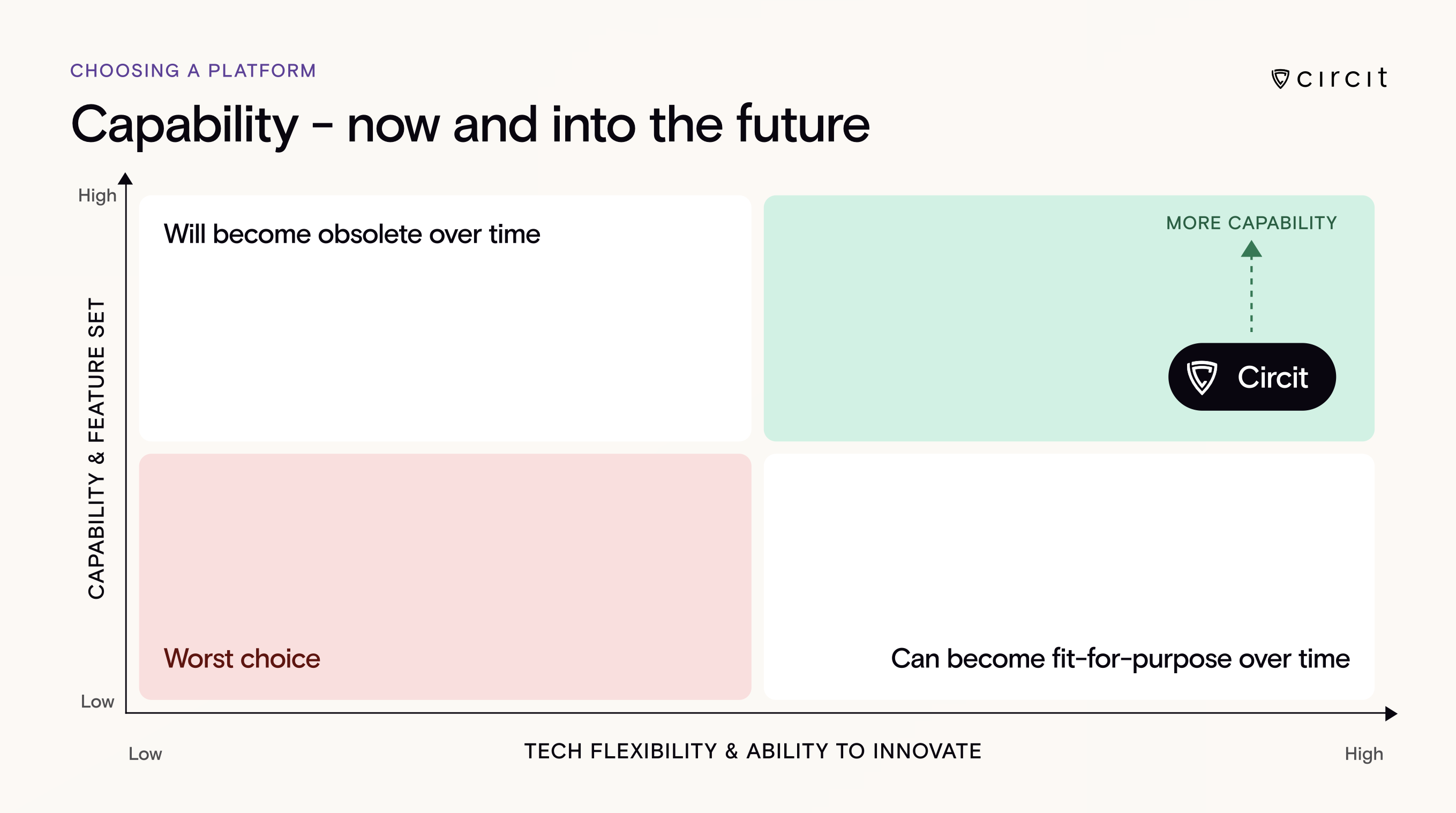
Bottom left is the worst choice. Bottom right can become fit for purpose over time. Top left is the most deceptive of the four: strong on a feature list, but sitting on foundations that cannot move quickly, so the only direction realistically open to it is down. Top right, capable now and built to keep adding capability, is where you want your supplier to be. In the asset verification industry, that is where Circit sits.
Where a platform sits on the horizontal axis today is where it will sit on the vertical axis tomorrow.
Circit has an excellent engineering team, but we did not make a single architectural decision that any experienced, competent technology team would not make if they were starting today. Cloud native. API first, with atomic endpoints. Componentised around a configurable data model. Built on the best and most secure infrastructure available. None of it is top secret, and none of it is secret sauce.
What it does mean is that we can offer a platform and a client experience that a system designed more than ten years ago simply cannot match. Not because the people maintaining those systems lack talent, but because you cannot replace the foundations of a building while everyone is still living in it. Every platform is bounded by the infrastructure it was built on. That is not a criticism of anyone. It is just physics.
It also means the gap does not close over time. It widens. The same foundations that let us build what we have today are the ones that will let us meet what our clients, our partners and the industry expect in five and ten years' time. Every new capability we add is built on components designed to be added to. That is the real value of the top-right quadrant. It is not only where a platform is, but where it is able to go.
The safe choice has moved
For a long time, choosing the biggest and best-known supplier really was the safe decision. None of the conditions that made it so still hold. The alternatives are many, they are better built, and they are visible to everyone your organisation works with. The supplier you chose for its heritage will be judged, along with you, on what it delivers rather than where it came from.
Choosing a legacy platform today is a decision to fall behind slowly, on a schedule set by somebody else's ageing infrastructure. The brand does not protect you. It exposes you.
Nobody ever got fired for buying IBM. That was then. Today, the person most at risk is the one who chose the safe option when a better one was sitting right in front of them.
P.S. If you have ever wondered where the cult-like side of modern tech and startup culture came from, well, that was also IBM. The strict dress code was only part of the story. The company also had its own songbook, which staff were expected to sing from at conventions and training days. Here is a genuine excerpt from one of their "hymns":
T. J. Watson, we all honor you, You're so big and so square and so true, We will follow and serve with you forever, All the world must know what I.B.M. can do.
-- From Songs of the I.B.M., the company songbook, 1930s
Better software, and no singing. Things really have moved on since IBM's heyday.